“Chickens Need Chicken Friends!”
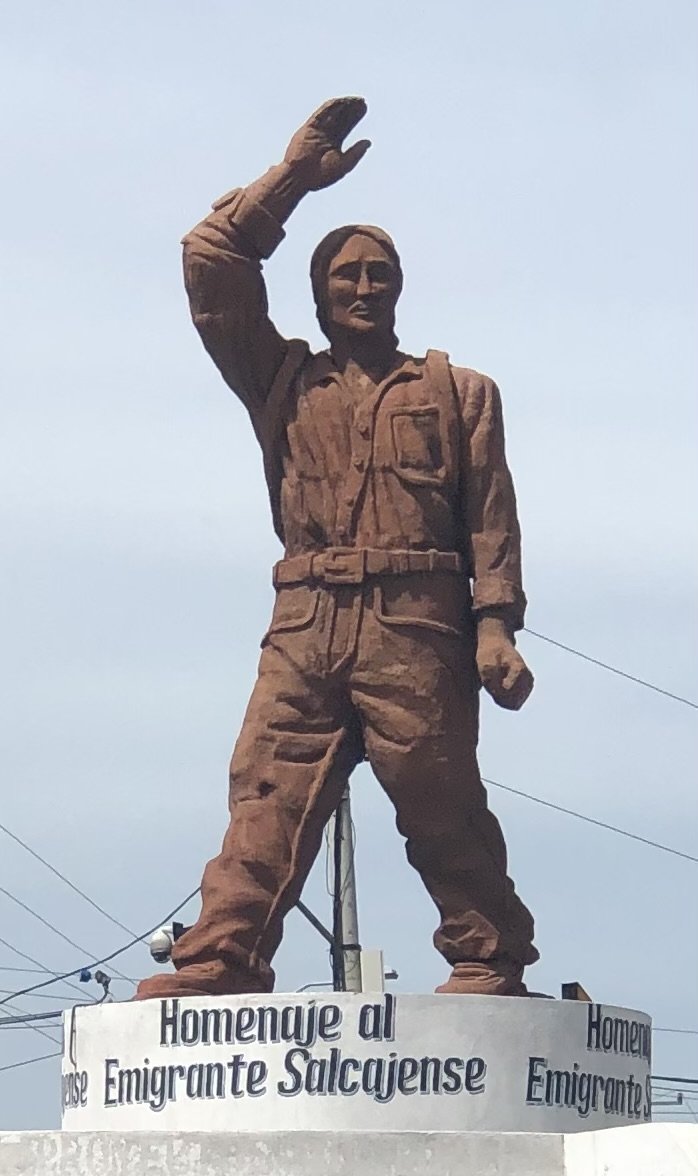
A prominent statue of a migrant headed north at an intersection not far from Totonicapán
The first two steps in telling a story are to introduce the protagonist and to explain their problem. In the story, “Chita, the Most Famous Chicken from Toto,” the central character, a chicken named Chita, is mentioned in the title, however, it is Diego who is the hero of the tale. In a previous post, Discovering Chita, I shared details about how we finally solved the mystery of who began the tradition of the chicken-head bowls from Totonicapán, but I didn’t really share about how the story of Diego came to be. While I had hoped to hear that the chicken-head bowls were rooted in some ancient Mayan tradition or some other extraordinary tale, the truth was far less satisfying: the artist added some left-over clay to a bowl in an uninspired moment of fleeting creativity. Indeed, chickens aren’t even native to the Americas. Perhaps instead of asking about the road, we should be asking, “why did the chicken cross the ocean?” I had the idea to focus on the capricious chicken-head bowls from Toto, but what struggle or problem would I build the story around? To understand this, you need to know a little more about the me and the Guatemalan Highlands.
I was born in Morganton, North Carolina in the late 1960s. As a child, I didn’t have any idea the nearby town of just under 15,000 people and much less still about the larger world or. My world was confined to our family farm, which lay at the end of the mile-long dirt road at the very end of the bus route and my elementary school. I was a teenager when I first met a Spanish-speaker. My father had hired a group of Guatemalan migrant farmers to help with our green bean harvest, and I will never forget how mesmerized I was hearing their perplexing chatter as they worked. It is difficult to know for sure where it all began, but this experience absolutely contributed to my lifelong love of culture.
I travelled to Mexico as a first-year anthropology student at Western Carolina University. The following year, I spent the summer abroad studying at the Universidad de las Americas in Puebla, Mexico. By the time I made it to graduate school, my captivation with all things Latin American was a deeply engrained part of who I am. By the mid-1990s, I observed how my own hometown had begun to evolve into an increasingly diverse community. Hundreds of Hmong families had flocked to Burke County after the years following the Vietnam War. Perhaps drawn to the similar landscapes as those in Laos, Morganton now has the fourth largest population of Hmong people in the U.S. However, another migrant group had also begun to emerge, the “Maya of Morganton.”
Recruited from the Western Highlands of Guatemala to work on poultry production and processing plants, Morganton became an anchor community for a growing number of Guatemalans and other Latin Americans seeking economic opportunities and fleeing violence in their own countries. I remember overhearing Guatemalans in colorful clothing speaking Spanish, Mam, K’iché, Ixil, and a variety of other Mayan dialects at Walmart in Morganton. In the middle 1990’s local furniture factories and other manufacturers were beginning to close as many companies began to seek cheaper labor outside of the U.S. Economic uncertainty fueled the tensions many locals felt towards the stream of immigrants connected to Guatemalan communities over the next two decades.
In 2015, my wife and I moved to Central America for my work, first in El Salvador and then later to Guatemala. During this time, I had the opportunity to visit all 22 Guatemalan departments (like states in the U.S.) and I formed meaningful relationships with many local leaders and community representatives. I also had an opportunity to observe how out-migration affected Guatemala. Besides the economic transformation and the undeniable, and growing, reliance on remittances from the U.S., families had been divided and friendships had been interrupted. Cultural diffusion undermined many local traditions and young people began to understand that their best chances for a better future were in the North. The evidence of this evolution can be seen throughout the country, but especially in Western Highlands communities like Totonicapán.
In Toto, everyone has a family member who has emigrated. Young workers go to the U.S. and the elderly stay home to care for those left behind. Teachers consolidate classrooms as many children have migrated too. Some children travel with their parents while others hope to be reunified with their loved ones who are waiting for them on the other side. Single mothers maintain households and eagerly await bank deposits from husbands whom they haven’t seen for years. And, amid all this separation, disruption and loneliness, the economic desperation, and worries about personal security continue to flourish.
As you read the story of Chita, you’ll notice that Diego’s parents or siblings aren’t mentioned, only his grandparents. You’ll notice that Diego’s best friend Conchita has gone somewhere in the north and that he communicates with her only through video chats. Such is the life for many children living in Guatemala. Yes, “Chickens need chicken friends!” but those left behind need friends too. Through this story, Chita helps Diego to form new friendships and offers hope for others who are similarly separated from their loved ones.